
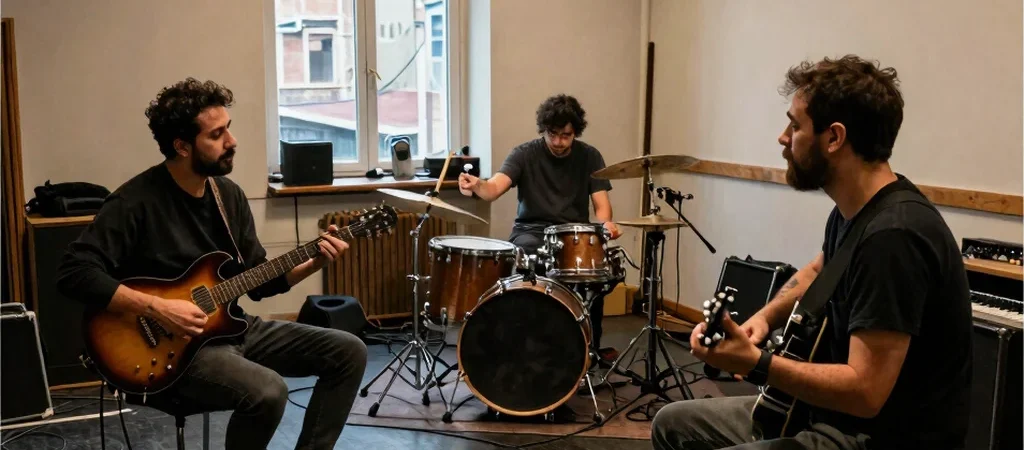
A rehearsal room tells the truth before a stage does. The drummer counts in, a cable crackles, and someone asks to run the chorus again—not because the song is broken, but because it has not found its shape yet. In Istanbul, where music moves between practice rooms, small venues, and the street, that unfinished hour deserves attention.
Listen for the decisions
The useful details are usually modest: a guitarist lowering the volume, a singer changing one word, the band leaving a beat empty instead of filling it. These choices show how musicians are listening to one another, not just how loudly they can play. They are also the parts of a song that can disappear beneath a crowd.
Rehearsal is not a romantic backstage montage. It is repetition and negotiation, shaped by the room’s acoustics and whatever the group can bring through the door. The sound that reaches an audience begins with those practical limits.
Follow the sound outside
A song changes when it leaves the room. At a gig, the mix shifts with the space, the audience answers—or doesn’t—and the musicians have to make decisions in real time. Afterward, the route through the neighborhood becomes part of the memory: a noisy street, a quiet side lane, a ride across the water with the chorus still looping.
Next time you hear a local band, listen for one thing beyond the hook: a pause, a rough edge, or the way two players leave space for each other. It may tell you more about the group than a polished introduction ever could.